Amongst many
untold stories of Ramayan, the myth of Mahiravan and Ahiravan is one such
story. Untold, as they get added in due course of time, or are specific to a
culture while they remain unimportant for many. We will analyse this later, but
first the story.
After, Ravan
lost his brave son Indrajeet in the battle, he was crestfallen. His mother met
him and reminded him of what he had done to his family and how he was wrong but
his arrogance was not allowing him to see through the web woven by him. Ravan
was not willing to listen to anything and from anybody.
Before leaving,
his mother reminded him of one of his sons (some texts refer to him as
brother), Mahiravan, who was ruling in the Patala-loka,
or the underworld. Mahiravan had initially decided not to be a part of the
battle, as he did not agree with the kidnapping of Sita. Mahiravan was the
master of occult and was a devotee of Goddess Kali. Ravan managed to convince
Mahiravan by telling him that if he could offer Ram and Lakshman as a sacrifice
to the Goddess Kali, she would be happy.
When news of
Mahiravan’s joining the battle reached the army of Ram, they were worried,
especially Vibhishan, Ravan’s brother. Vibhishan knew about Mahiravan’s
abilities to change forms due to his mastery in sorcery. He warned all to
ensure that Ram and Lakshman were guarded well and appointed Hanuman to
ensure that none got in the cottage of Ram and Lakshman. Hanuman created a
shield by his tail, around the cottage where the two were resting and ensured
that none could break the barricade.
Mahiravan tried
many forms but could not pass through. At last, he assumed the form of
Vibhishan and approached Hanuman. He asked him to be allowed in, just to ensure
that Ram and Lakshman were fine. Hanuman, allowed him to pass without realising
that he had just breached the security created by him. As soon as Mahiravan got
in the cottage, he cast a spell on both Ram and Lakshman, and took them deep
inside the ground. By the time Hanuman and Vibhishan could realise, they were
gone. Vibhishan was very worried as he knew what could be the fate of the two.
He urged Hanuman to do something.
Vibhishan
explained that the two were taken deep inside the ground in the patala-loka and Hanuman should go the
same way. The adventures of Hanuman in the patal-loka
are interesting, but we will not get into the details of it. It is said that
when Hanuman reached the patal-loka,
it seemed to be a city by itself, with forts and fortresses and guards at every
point. After eliminating all opposition on his way, he met one, who seemed to be
quite a match for him. This character is known as Makardwaj. We will discuss Makardwaj in the next
part of this article.
On his way to
the patala-loka, Hanuman had heard
that Mahiravan was going to sacrifice Ram and Lakshman to the Goddess Kali in
return for more occult powers. The myth gets interesting here.
Hanuman takes
the form of a small bee and approaches the goddess Kali. He asks her, if she
wanted the blood of Ram. Kali is supposed to have said that she would rather
have the blood of Mahiravan, than that of Ram. She then goes on to suggest a
way out, which Hanuman whispers in the ears of Ram. Ram and Lakshman were
readied for the sacrifice and at the auspicious time, Mahiravan asks Ram to put
his head on the sacrificial altar and ready himself for the sacrifice. Ram
said, that he had been a Kshatriya, a warrior, all his life and had never known
how to bow in front of anyone, could Mahiravan show him how to bow? Mahiravan
was irritated and tried to demonstrate. No sooner had he done that, Hanuman who
was hiding behind the idol of Goddess Kali, assumes his form, takes the
sacrificial blade and beheads Mahiravan. Thus Ram and Lakshman were saved. He
then offered the blood of Mahiravan to the goddess.
Another
interesting version adds that killing Mahiravan was not going to be that
simple. His life was distributed in five different flames around the temple. If
one flame was extinguished, it would come up again; so the flames had to be
blown off all together to kill him. To achieve this task, Hanuman took the form
of Panch-mukhi, or five-faced. By
doing this, he could blow all the flames together, thus killing Mahiravan.
Matters don’t
end here. Mahiravan’s wife was pregnant and it is said that when she came to
know about the death of her husband, she joined the fight. In the commotion
that is unleashed, Hanuman’s kick lands on her stomach and out comes their
child, Ahiravan, ready to fight. Ahiravan is full of blood and mucous, and was
tough to get hold of and was proving to be quite a tough match. Hanuman manages
to throw some mud on him, gets his hand on Ahiravan’s limbs and dashes the
child on the ground, killing him instantly.

Hanuman then
carries both Ram and Lakshman back to the battle field.
This myth is
found mainly in the Ramayans of the East, especially in the Bengali version by
Krittibash, the passage better known as ‘Mahirabonerpala’.
The involvement of Goddess Kali and the occult practices find a mention in the
epic here. Also, Kali plays a positive role here and asks for the blood of
Mahiravan. There are many aspects to this myth –
Both Hanuman and
Mahiravan seem to have similar powers to change forms as we have seen, but both
use it for different reasons. Hanuman’s role of the killer and a blood-thirsty
one at that, especially the way the child Ahiravan is killed bears testimony to
the tantric angle to this myth. A very different form of Hanuman, which has rarely
been seen. Hanuman has always been portrayed in a submissive, but brave and
strong disciple of Ram. Such violent form has seldom been portrayed, and this
could be region or even audience specific.
The entire myth goes
on to highlight the importance of Hanuman. In the entire episode, there has
been no role in terms of action from Ram and Lakshman. Very clearly this is a
myth which goes on to add heroic credentials to Hanuman.
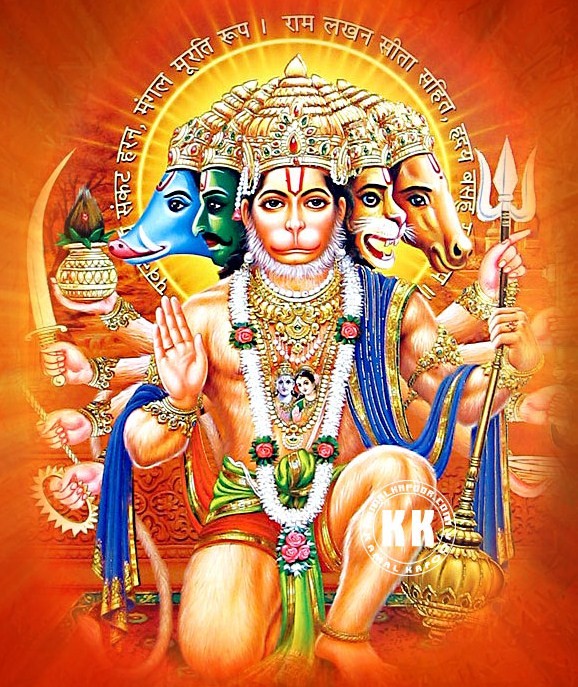
Many also see
this as an aspect of ‘myth-making’ to justify the creation of the Panch-mukhi Hanuman, akin to creating
the means, to justify the end. An important aspect of this Panch-mukhi Hanuman is the five faces. The five faces are that of
Hanuman himself, and the other four being that of Hyagriva (horse), Varaha and
Narasimha, all three being forms of Lord Vishnu and the final being that of
Garuda, again a vahana of Vishnu. In
this myth, Hanuman is given the importance of Lord Vishnu himself, which makes
him at par with his Lord! While this is strange, such comparisons are not
unheard of.
Also, keeping
with the theme of the Bengali version of the epic, Ram plays a very passive
role. A similar underlying theme can be found in the other neighbouring
versions, like the Oriya, Assamese, etc. In the actual text, Ram is shown as
crestfallen and is even scared at his predicament, when he is about to be
sacrificed, a far cry from many other versions of the epic where he is the
dynamic hero who gives the war cry.
Many scholars
have opined that this has a folktale motif and has blended well in the epic. The
changing of forms, sacrifices at the altar of Goddess Kali, etc. are very
common folktale motifs in the East. The twist of the ‘sacrificer’ getting sacrificed
is also a common folktale element, which highlights that gods don’t support
their ardent devotees if they take the wrong path.
All in all, a
very interesting myth.
Next time, we will continue this
one with reference to Makardhwaj….. Keep reading…


