A Blog on Mythology and occasionally on Reality.


This is a Blog on Mythology, both Indian and World and especially the analysis of the myths.

In effect, the interpretation of the inherent Symbolism.


Pages

Showing posts with label Hero. Show all posts

Tuesday, July 30, 2013

Bhaag Milkha Bhaag


A recent viewing of a very popular Hindi movie, Bhaag Milkha Bhaag has set me thinking a bit and I am reproducing the thoughts here.


Every hero has a reason to achieve his heroic heights, both mortal and mythological. According to Greek mythology, Hercules had murdered his wife in a fit of anger, and so he set out to atone for them and thus goes the tales of his twelve heroic deeds. Perseus set out on an adventure to bring home the head of the Gorgon Medusa just to prove that he was not a good-for-nothing Greek, but was brave and could do what no mortal had even tried to.


In Ramayan, Ram wanted to get his kidnapped wife back and set a regime of rightful rule in Lanka and thus the battle in Ramayan, which saw his heroic best. Hanuman wanted to do anything and everything to please his idol Ram, and did whatever he was told to, in the process, achieving feats which were inhuman. Arjun in Mahabharat achieved his heroic deeds by the sheer dint of reaching a target which none could and become the best archer in the world then. Amba took the birth of a eunuch just to achieve her sole objective of being the cause of Bhishma’s death. Numerous examples abound in different mythologies, where heroes have reached the peak of their heroism, at some point of time for something or the other.


It was no different for the ordinary mortal Milkha Singh. As a child he ran to school to reach on time and avoid being caned by his teacher, and then during the partition, he ran to save his life. Later he ran fast to avoid getting caught by the railway guards. As an army jawan, he ran for a glass of milk and then for the Indian blazer. He continued to run for something or the other, till it became a habit to satiate a particular need. Does this mean that if you do not have a material cause or a need, you do not achieve heroic heights?


No, many have achieved great success out of passion too. Many actors have achieved stardom out of sheer passion for the art and not primarily for the money. Certain doctors have achieved near-god status, out of the sheer desire to cure. Environmentalists have pursued their mission-like objective just to provide a clean atmosphere for the future generation without any gain for themselves. But even here there is an underlying need, excellence.


So what is the underlying common factor among all the above, irrespective of the status of divinity or mortality that sets man, to achieve what is unachievable for many? The word is motivation. Nothing can be achieved without some motivation. Hercules was motivated by getting to wash of the sins of murder, Perseus wanted to prove that he was not a useless son citizen who could not afford a gift for the King on his wedding. Ram was motivated to get his wife back, Arjun wanted to be the best archer on earth and Amba wanted to avenge her insult. Even the mythical characters had an objective, just as Milkha had different motivations at different stages of life.


Without a motive, there is no motivation. Even altruism is a motivation behind donating huge chunks of personal wealth!


What is your motivation and what does it want to achieve? If all of us ask this basic question, we know what we want and where we have to reach. This objective and the motivation to achieve it, differentiates man from cattle, the leader from the herd.


Tuesday, February 12, 2013

Fallen Heroes


Lance Armstrong

The recent ban and subsequent confessions by the world-renowned cyclist Lance Armstrong, has shocked the world and more so, his fans. How could someone who people looked up to confess to all the charges of doping? A hero for millions, confessing on international TV, that he had cheated came as a crashing blow to many who had idolised him.


Rajat Gupta
Some time back, the same happened with the likes of Rajat Gupta, Tiger Woods and Ben Johnson, to name just a few heroes who came crashing down the pedestal they had been occupying.


Mythology is replete with such heroes who occasionally have displayed a fault in their personality. Be it Yudhishtir’s weakness for gambling and Bhima’s craving for food, from the epic Mahabharata. The grandsire of all, Bhishma too was criticised for his vow to serve the throne, which made him commit some grave mistakes. Or be it Lakshman renowned for his anger, a significant weakness in his character, from the epic Ramayan. Had it not been for pride and arrogance, then Ravan would be of heroic traits, instead of the certified villain in the epic Ramayan. Hercules, a Greek hero, known for his heroic acts (and thus the phrase – ‘herculean tasks’), was prone to bouts of anger, during which he would forget what he did. It was during one such bout, that he ended up killing his wife and children.


Macbeth killing Duncan
Literature has given us one such hero in Shakespeare’s Macbeth, who had all the qualities of heroism, but the same, came with an ambition which went far beyond morality. His ambition, adequately fuelled by his wife Lady Macbeth, makes him commit the crime of murder one after the other, all leading to his ultimate tragic end.


Tiger Woods
But Armstrong, Gupta, Woods and others are heroes of modern times. They are not characters from mythology or literature, but ordinary folks like you and me. When Armstrong won his battle with cancer and then went on to win seven consecutive Tour de France victories, then it sure was something beyond human capability, or so it seemed. Rajat Gupta career was every middle-class Indian’s dream. From a brilliant academic to the first Indian MD at McKinsey & Co., to a well-known philanthropist, he had it all, till his conviction on charges of insider trading, a crime that cost him a successful career and a jail term. Tiger Woods, a golf legend too had it all, victories, endorsements, a fairy-tale life, till all came crumbling down when his wife accused him of infidelity and later divorced him for the same.


Just what is it that goes in the making of such heroes and why is it so hard on their fans than them?


Yes, they cheated, but they cheated in a sport or to their spouses or organisation, not you and me. But, we still feel cheated.


Ben Johnson
Why are we disappointed when a hero fails either in an achievement or in character? Are these heroes really ‘god’ as we refer to them sometimes? Who has given them the demigod status? Did they ask for it or is it a big crime that they got swayed in the huge public adulation? Someone has very pertinently asked – “What is the worst thing about Armstrong’s alleged drug use: that he won unfairly, or that he spoiled the glamorous story we constructed about his triumph over cancer and subsequent victories?” I say pertinent, because it is we who make them heroes first and then expect them to live up to our glamorous construct. In them we see the ability to perform those feats that we as individuals can’t even dream of or couldn’t achieve, failed to be precise. They are the heroes who are just short of a new god that we see in the not-so-distant horizon. In their failure, we see a failed image that was nurtured for so long. The fans are hurt and disappointed. When the hero is caught cheating, our faith in him is hurt and it is hard on us to destroy the image, and when we destroy, we do it with far more vengeance than was expected.


We are in the 21st century and there are no demigods anymore. Mythology and Literature is not reality, but should only be a point of reference, if at all. Reality is that all those guys who act, perform, play, sing, write or work are mere mortals, slightly better than you and me. Look up to them, but don’t worship them. Follow their paths for the better of it, but don’t worship the ground they tread.


The moral of the story is – Make no gods out of mortals and thou shall not be hurt!


Wednesday, January 30, 2013

Was Gandhiji an Avatar?


On the day of Mahatma Gandhi’s assassination, Martyrs' Day, the above question comes to mind, which is also the very basis of what we call the ‘deification of a hero’ in the studies of Comparative Mythology.


Would generations after a few hundred years believe, that a man managed to unite a diverse and large country, which was many small countries by itself, achieved freedom from British and that too on the principles of ahimsa or non-violence? Many historians and scholars have found people in villages to believe that Gandhiji was an avatar of god – how else could a person perform such enormous task of throwing the British out, when they were firm for more than two hundred years?

Many have compared Gandhiji with Gautam Buddha, probably for the glaring similarities between the two – 

  • Both were born in families which were well off – Gandhiji was born in a well-to-do Gujarati family of a businessman and Gautam was born to a King.
  • Both had a happy childhood and were educated – Gandhiji went on to become a lawyer and Buddha got princely education
  • Both were married and had children
  • Both had events which led them to their individual quest – Gandhiji had his experience while working in South Africa, while Gautam experienced the four sights, both of which were turning points for them individually
  • Gandhiji returned to India in his quest for swaraj, while Gautama left his kingdom to seek nirvana
  • Both were against violence and proposed simple living
  • Both were against the caste system and worked for the downtrodden and the untouchables
  • Both had followers who have fought later – in the case of Gandhiji, a nation got divided and in the case of Buddha, his faith was divided as differences crept in, in the form of Mahayana, Hinayana and even the Tibetan Buddhism.

Just what am I up to, is what many might wonder. Why am I hell-bent on deifying an individual from History?


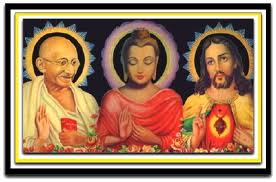
The whole idea is to show how heroes of the past have got deified. This is exactly how many of the ‘gods’ could have got deified in the course of the development of civilization. Miracles and unbelievable deeds get credited to them; halo’s appear in their pictures. The classic example in mythology is that of Indra from the Vedic times, where many believe that Indra was a mortal hero who got deified during the Vedic times. Many also feel that the epics Mahabharata & Ramayana could have some roots in reality and many characters actually existed.


The following pictures have become part of the lore. The picture below is titled as “Gandhiji ki Swaryatra” – Gandhiji’s journey to heaven, by Narottam Narayan Sharma in 1948 where Gandhiji is shown above Nehru and Sardar Patel and being taken in some sort of celestial carrier by two garlanding apsaras after his death. Many other leaders are shown mourning.


The following picture shows a pensive Gandhiji being blessed by Lord Ram, a deity Gandhiji used to worship, made more famous by his last words “He Ram”. This image, set up in modern times (modern buildings and manicured lawns) with Lord Ram in his traditional attire is also seen as the ‘appropriation of Gandhiji in the Vaishnavite tradition of Hinduism’.


Besides the above, there are many such pictures which deify Gandhiji and many other freedom fighters like Bhagat Singh, Netaji Subhash Bose to name a few.


What is interesting is that this theory of deification of heroes is not new. I would rather say, that it has only slowed down in the modern times. What were once mortals have either been raised to the status of gods or changing times have made their deeds so unbelievable, that such deeds could only be the domain of deified heroes.


To conclude, I would like to quote what Albert Einstein had to say about Gandhiji on his 70th birthday - “Generations to come, it may well be, will scarce believe that such a one ever in flesh and blood walked upon this earth”.


As lawyers would say – I rest my case!

As mathematicians would say – Q.E.D.!!!


Picture Courtesy - 'Photos of the Gods': The Printed Image and Political Struggle in India