A Blog on Mythology and occasionally on Reality.


This is a Blog on Mythology, both Indian and World and especially the analysis of the myths.

In effect, the interpretation of the inherent Symbolism.


Pages

Showing posts with label Ram. Show all posts

Wednesday, December 3, 2014

The Insecure Theist

The kind of intolerance that is prevalent in the society today, makes me wonder the direction that we are heading towards, progressive or regressive? There is a growing intolerance to views which do not confirm with a certain segment of the society. The intolerance takes to violent recourse to ensure that the dissident voice is stifled, at times quite harshly, ensuring that the voice is done for ever and an example is set for a long time to come.

Were we an intolerant society since time immemorial or is this regressive intolerance a recent phenomenon? Are we emulating what we have inherited or are we creating new means to enforce and ensure a particular way of thought? Is anti-religious views anathema to a society which has a long and a diverse religious tradition?

Sometimes it’s worth looking at our past for many of our present day problems. Many might say that atheism and such thoughts are a recent phenomenon, as the ancient man was always god-fearing and had faith in god. There is as much truth in that as there is in the statement that the month of January has 38 days!

History is witness to the philosophies like Charvaka of the Nastikavada, i.e. the philosophy of atheism. Charvaka philosophy believed in the theory of materialism being prime and preached religious indifference. The philosophy challenged the existing notions, “There is no heaven, no ultimate salvation. No soul exists in the next world, nor are the actions of the four varnas fructuous in any way. .......If the animal sacrificed in the jyotishtom yagna goes to the heavens, why does one not sacrifice his own father?...” (as mentioned in Sarva Dharma Sangraha by the 14th century philosopher Madhava Acharya). It denied all the doctrines of the major religions of the day and believed in indulgence of sensory pleasures, as the sole objective of any life.

While the objective here is not to subscribe to the said theory and elevate it to a higher level; this is just to prove, that there were proponents of such theories who believed that the Vedas were tainted with untruth and self-contradictions. However, none stoned the proponents and nor were their works burnt and banned. This brings me to an excellent example of tolerance of divergence or even anti-religious views as seen in the epic Ramayana.

Jabali was a sage in the court of Dasharath, the King of Ayodhya. Jabali was an atheist and did not believe in any of the religious texts or rituals. His anti-religious views often made him ridicule the established rituals prevalent in the society then. On one of the occasions, he was supposed to have made fun of the post-death rituals by saying, that offering food to the dead, during the period of shradha was a sheer waste of food; whoever had heard that dead people could eat! He even went on to say, that the scriptures that contained the rituals for worshipping gods and the yagnas and other such rituals were prescribed by wise men only to keep people subjugated in the name of religion.

It is interesting to note as to what someone with such allegedly ‘devious’ thought process, was doing in the court of the great King Dasharath. Dasharath was of the opinion, that there were all sorts of people in his kingdom and if there was anything to do with such people, then Jabali would be the right person to understand them and help mete out justice to such people, since there was every possibility of the others condemning them even before their trial, due to their initial disposition towards religion. Truly, a broad-minded outlook given the times.

This further gets reinforced, during an episode in the epic Ramayana. When all who had gone with Bharat to persuade Rama to return to Ayodhya had failed, Jabali was supposed to have tried to convince Rama in his own inimitable way. He is supposed to have told Rama, that he was taking his father’s wishes a bit too far and as a designated King of Ayodhya he had every right to ascend the throne and enjoy the fruits of royalty. Man was born alone and died alone, and clinging to such parental emotions was man’s undoing. Just to honour some wish of his dying father, his leaving the comforts of a palace for forests, was nothing short of foolishness and it would be sensible to return to Ayodhya. Jabali felt rather strange that a man of Ram’s stature should leave a concrete objective like ruling the kingdom of Ayodhya, for some obscure religious norm that he wanted to honour.

Needless to say, that Ram was angry and wondered how his father had kept such a person as his advisor. What follows is a dialogue where Ram justifies his actions, and during the course of what seems to be a reprimand of sorts, calls him an atheist. Jabali is said to have withdrawn and ended the entreaty to return, with the words that based on the circumstances, he changed his belief system to suit the occasion. When needed he became a believer and when required he became a non-believer. While these words were seen as the words of an opportunist, we will debate this a little later. Having said what he did, Jabali was supposed to have withdrawn and went back to Ayodhya like the others, except that after the death of Dasharath, and during the exile of Rama, he was seen as an outcast, and he was supposed to have left Ayodhya.

Many like Dr. Pradip Bhattacharya have referred to Jabali as a ‘Freethinker par excellence’, while many have seen him as a rank atheist and taken Ram’s reproach and reprimand as the final word against atheism. Many have gone to suggest that Jabali made those radical statements only to coax Ram to return to Ayodhya and he didn’t quite mean the words he used, and the final words were an indication to that. However, the final words that he changed his views based on circumstances, had more to do with the typical dilemma, a lot of us have in mind. Did god really exist? Some aspects denote the presence of a Supreme power, but some incidents make us question the very presence of such power, which seems benign at certain times. The statement was a case of dilemma which is what majority of the people suffer, when they are not so stubborn or dogged in their views about matters of God, and have an iota of grey matter to ask questions and not give in to blind belief system. The statement is apt when a simpleton does not get answers to his questions, and gives in to moments of weakness or frustration.

Jabali went on to write the Jabali Upanishad and the modern city of Jabalpur in Madhya Pradesh, India, is supposed to have been named after him. The origins of Jabali too make interesting reading.

According to Samaveda-Chandogyopanishad, once a sage came across a boy who had an intense desire to learn, but none were willing to accept him as a disciple. The sage asked the boy his name and he said, Satyakama. After this the sage asked the obvious question, about his father, to understand his caste and if he deserved education. To this Satyakama is supposed to have said, that he didn’t know the name of his father, but his mother had asked him to say, if asked, that he was the son of Jabala, which was her name. Not knowing the name of one’s father, meant questionable paternity and also put his mother’s reputation in question. But the sage could not overlook Satyakama’s intense desire to learn, and much to the displeasure of the others, the sage accepted Satyakama as his disciple who was since then also referred to as Jabali, the son of Jabala.


To conclude, I would urge the upholders of religion, that any religion stands by its own strength and does not need pillars to uphold it. Religion should be able to protect its followers and not the other way round. A fragile religion is a sign of weakness and any efforts to ‘save’ it would only prove counter-productive. Divergent views give way to debate and debates are a must for the thoughts to flower and find new meanings. Don’t thwart this growth and when the vision is faint, look back. Even Rama was sympathetic to the likes of Jabali, just who are you guys, if I may ask?


Thursday, July 3, 2014

Knowledge Transfer – Lessons from Mythology


Many organisations that I come across seem to have one problem (amongst many) in common and that is Knowledge Transfer (KT). People don’t want to share knowledge and at times people don’t find the existing knowledge worth taking (typical of the Gen X, who have just passed out of elitist colleges), or people not being able to collate and ‘hand-over’ a clearly articulated body of knowledge.


KT is the transfer of knowledge, expertise, skills and capabilities. Is KT a new subject on the horizon or is it just a new phenomenon due to insecurity of the modern day workplaces? KT in its basic form has existed from time immemorial in the form of Gurukuls, and then schools and colleges of present day. Teachers have taught and passed their knowledge to students, some of who have added to the body of work and passed it down to others in the subsequent generations.

Organisations too have seen such transfers earlier. Be they in the form of an Associate, an Apprentice, or just a junior who goes on to learn the tricks of the trade and take on the mantle one fine morning. Sons have been natural heirs, but others too have been honoured with the knowledge and have moved on to start on their own.

But transferring knowledge in an organisation is not as easy as it is in schools and colleges or small set-ups. In a modern-day knowledge based organisations, knowledge is critical. Besides managing knowledge which is in the minds of its employees, transferring the same on their leaving is a critical aspect where many seen to fail, and in many cases, the organisations are not even aware of the failure.

So how does KT become effective and a viable practise for organisations? How do they ensure that nothing is lost or at least substantial is retained before an employee leaves or retires?

KT is effective when the receiver is aware that there is knowledge worth accepting. When the leader is held in awe because of the knowledge, then the transfer is effective. In the epic Ramayan, Ravan was an able administrator. His rule was a golden period for his kingdom (which figuratively was referred to as sone-ki-Lanka, or the land of the gold). When Ravan was on his death-bed, he passed his knowledge of able administration to Ram, which in future came to be referred as Ramrajya. Ram who had dealt the deadly blow to his enemy, accorded Ravan the position of a Guru, and sat down to hear the words of wisdom from the dying asura-King. Knowledge should never die with the person who either created it or mastered it.


In the epic Mahabharat, Vidur has been shown sharing his knowledge of administration frequently with the Pandavs, which is also known as Vidur-niti. This is never done with the Kauravas, since they were never found receptive. Bhishma too promises not to die till he has imparted his knowledge of ethics, morals and values to Yudhishtir and the same was meticulously done from his bed of arrows after the tenth day of the war of Kurukshetra.

Knowledge Transfer is effective, when it is done by the person who is acknowledged to be in a superior position because of the knowledge. His elevated position is because he has some skill, knowledge in his possession. This is akin to the typical guru-shishya parampara where people have gone to acquire the said art or skill. It could be similar to Dronacharya, as a teacher who is willing to pass his skills to all the students in return of some favour, or Parashuram who is willing to pass down his knowledge to Karna in return of no favour.

Knowledge transfer is very effective when it comes in the form of need-of-the-hour. Krishna in his epochal Gita had transferred a huge body of knowledge at the right time to Arjun, which enabled him to fight the war of Kurukshetra. This knowledge till date is translated, interpreted and taught in different ways and the relevance of which seems to be reinvented with changing times.

Knowledge transfer is meaningful, when we know that the said knowledge emanates from reliable sources. The Vedas, Upanishads, etc. are all troves of knowledge which have been recorded for use. Some say, they were passed on by gods through seers for future use, while some say these are learning of the past recorded for generations to come. Even the epic Mahabharat is supposed to have been dictated by Vyas, but written by Ganesha – where is the reason to doubt such an epic which has been written by a god with his own piece of tooth?

Finally what makes KT most effective is the method of the transfer. Many a times, if it is passed down as tomes of knowledge, it is ineffective. Let me tell you a story here. Once upon a time there lived a king who had three sons and according to the king all his sons were idiots and he wondered how could he ever leave the throne to any one of them, when none of them were worth anything? His worry was solved by a person, who promised to educate his sons and make them worthy of the throne. This man focused on the wisdom of the scriptures rather than the scriptures itself. He created stories which would teach a lesson or a moral and make the learning more interesting, instead of didactic or moralistic. Soon the Princes were a Kings delight and each one of them was eligible to occupy the throne! This man was none other than the famous Vishnu Sharma and what he wrote for the princes is known to all of us Panchatantra! The Panchatantra or the five treatise cover all aspects of management, personal life and the cunning that one needs to have to face life.

Just as lessons are easy to impart, but not-so-easy to understand, so is the case with Knowledge Transfer. It is easy to speak about it, even easier to lay down
Courtesy Dilbert.com
the processes that govern the transfer, but very complex to execute. The biggest impediment to the process is the fear of redundancy. In an ever increasing competitive environment, ones knowledge is perceived as ones asset acquired over a long period of time and to pass it down as a process does not settle well with an individual who is feeling insecure in the first place. Needless to say, that the same cannot be done overnight too, after all KT is not a case of divine revelation!

KT needs to be part of an organisational process from day one. Every process or step in an organisation should aid the Knowledge accumulation leading to its dissemination. It has to be a top-down approach. A Bhishma needs to be visible to the system who is willing to share his knowledge or a leader like Ram needs to be seen in all humility willing to accept knowledge from even his enemy.

The day, sharing knowledge becomes a part of an organisations DNA, Knowledge Transfer will be seamless and as normal as any other regular process of the organisation!

Thursday, November 7, 2013

Changing faces of Lord Ram


I don’t know how Lord Ram looked when he was born or even before I was born, but let us see how he has evolved in his depiction over the last 6 decades or so. This evolution of Ram is not just due to changing ‘tastes’ and/or perceptions of the new generation, but this could also be seen as the political evolution of Ram for the sake of some select few who have become the owners of this new Ram. However, the metamorphosis is interesting and speaks volumes of his worshipers and the society at large, who have accepted these changes.

The above picture is a painting by Raja Ravi Varma (1848 – 1906) who was the first to put faces to our mythological heroes. In this picture, Ram is seen as a true ‘vanvasi’ and does not look the bedecked hero that we know him as. Though Ram is seen striking an aggressive pose, since he is trying to shoot an arrow to calm the raging sea and Varuna trying to pacify him, he is not the warrior god as yet. If seen in context, this is a picture from the ‘yudh-kanda’, i.e. the war-phase, so this is not entirely out of context.
The one above is the picture from around the 50’s where Ram is shown as a gentle and a quiet god, with his palm raised to bless. Though he is shown carrying the bow and arrow, it does not dominate the picture. The bow and arrow could be seen as a pictorial reference of Rama being a Kshatriya, and probably nothing beyond. The action of the usage of the weapon is missing. His slight smile and a mild demeanour depict his genteel nature that is in the minds of many for long. Nowhere does it betray the image that would be coming up during the next few decades.

The picture above is from early 70’s which is much the same as far as the facial expressions are concerned, but the posture has undergone a change. Ram is now gaining an aggressive posture with the bow and arrow coming in prominence. The background of raging seas and burning sky adds to the spirit of aggression that is being depicted. But let’s not lose sight of the fact that the face is still smiling non-aggressive.


This one above is an image of early 90’s and undeniably a complete transformation from the erstwhile image of Ram. Here Ram is the warrior god and out to avenge all that his followers claim to be. This is the picture that was pasted all over the country by a certain organisation that seemed to champion the cause of the majority. Ram here is an aggressive god and has lost the genteel image that he had for so long. The hand raised in blessing is completely missing and his physique is more muscular and warrior-like. The adornments are all gone and all you see are signs of a warrior out to wage a war.

Finally the latest! The above picture is from a much forgettable animation film made in the year 2010. In this we see Ram as a modern day warrior god all with six-pack abs and in a form never seen before. The weapons though the same, the arrow has undergone a transformation along with the looks of Lakshman and Hanuman. They look more Nordic in their forms and any signs of benevolence, etc. so associated with Ram till a few decades back are completely missing. The well chiseled face, the biceps, the abs and the flowing locks all with a background of destruction (with the eagle thrown in), and the massive arrow is straight out of a Viking inspired war game.

Times change and so do our tastes, just as our needs and wants. In the case of Ram, this seems to be no different. Raja Ravi Varma’s depiction was more for us to have an idea of what gods could be like. They resembled more like us as we were, simple and not necessarily shapely. Then came the calendar art, which ensured that the gods be seen in all the splendour and finery that make then different from our mortal selves. The halo, the ornamentation, the silk finery and the heavenly looks that made them worthy of worship, were added.

Thereafter some gods became subjects of politics and we started making them accordingly. A subtle god like Ram became aggressive and his hands that were always raised to bless now took up weapons to avenge, what his worshipers wanted him to. Suddenly Ram became owned by a few who decided how he would look and what he would imply by the looks. Even before this could be resolved, some people decided to give him a makeover. To make him more acceptable, he was given a new look, yet again. Ram now was a complete modern man, all with the six-pack abs and the biceps and triceps which gives a feeling that the jungle where he spent for his exile must be having a gym with all the modern equipments!

A recent blog has come up with the interpretation of a young artist, which takes Ram (and other deities) in the genre of sci-fi. In this Ram is depicted as a fierce warrior, clad in flowing animal-skin attire, shooting multiple arrows. He is sitting atop a flying, white-furred Hanuman with angry looks. Needless to say, that all the other depictions too are a major flight of fancy, which has caught the fancy of the new generation!

I have only traced the evolution of Ram from Raja Ravi Varma to now. I am not sure where and when will this stop; before man’s flights of fancy makes him do more harm than what has been done already.

I can’t but help remember the words of a song from an old Hindi movie, Hare Rama Hare Krishna, which says – “dekho o diwano, tum yeh kaam na karo, Ram ka naam, badnaam na karo………..


All pics are from the Internet;
4th picture is courtesy "In the Name of God - Ram Ke Naam, a 1992 documentary film)

Thursday, October 10, 2013

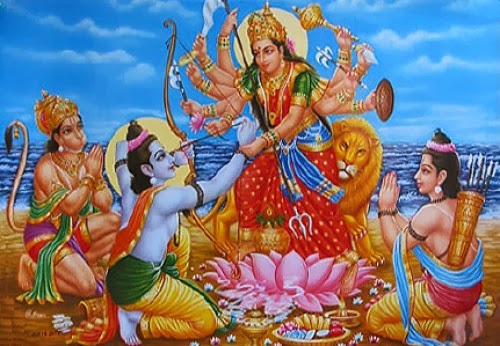
Durga Puja and Lord Ram


Durga Puja begins today and is an important festival in West Bengal and the Eastern parts of the country and the entire Bengal wears a festive look. People celebrate the festival with all the gaiety and revelry that goes along with it.


Durga Puja is the celebration of the killing of the Mahishasura (This is Utkarsh Speaking: Mahishasura ) who had become a threat to all the gods and humans and was invincible except by a woman, due to a boon. After a fierce battle, Goddess Durga kills the demon.


However, this festival initially did not take place at this time of the year. An interesting need-of-the-hour is the cause of the celebrations at this time.


According to the Bengali Ramayan by Kritibash, Goddess Durga was worshipped in the spring season (and thus Durga Puja was also referred as Basanti Puja, the festival in the spring season), and never in autumn. But after an inconclusive battle with Ravan for many days, the gods advised Lord Ram to propitiate Goddess Durga and seek her blessings. But Goddess Durga was never worshipped in autumn, and thus Ram’s propitiating the Goddess is referred to as Akal-bodhan, akal meaning out-of-turn or out-of-season and bodhan meaning worship or invocation. In due course of time, the region started celebrating Durga Puja during the autumn and thus the festival is also known as the sharad-utsav or the spring-festival.


According to the same version of Ramayan, Ram took the blessings of Durga on the sixth day (Sashti) i.e. today, and went into battle with Ravan on the seventh day (Saptami) and killed Ravan at Sandhikshana or during the crossover between the eighth (Ashtami) and the ninth (Nabami) day, and cremated on the tenth day (Bijoya dashami).


The worship of Durga by Ram too has an interesting legend. According to some versions, Ram was advised to worship the goddess as she was considered to be the patron deity of the land of Kuber, i.e. Lanka before Ravan usurped it from Kuber and it would be in order to seek her blessings before invading the island. It is said that Ram needed 108 ‘neel kamal’ or blue lotuses to offer the goddess Durga and after a lot of efforts managed to get only 107 of them. Ram was also referred to as ‘rajiv-nayan’ or the one with eyes like lotus, and since he could not arrange for one more to complete a hundred and eight, he offered his eye by trying to pierce it with an arrow, but the goddess appeared at the right moment and granted him the blessings of victory. Some versions say that Ram did manage to get all the required lotuses, but the goddess hid one to test his devotion.


Since then, this has been a practice to propitiate Goddess Durga before heading for a war and the same is seen in Mahabharata, where Arjuna and Yudhishtir are mentioned to be worshipping Goddess Durga for the boon of victory. Later in history, we have seen Shivaji worshiping Goddess Bhavani, a form of Durga before heading for any battle.


It is interesting to see gods in their own right seeking blessings from goddesses prior to a battle. The cult of Mother Goddess was prevalent from the ancient times and Goddess Durga has always had a unique place in the pantheon. Though she is a goddess created by the gods to fight a demon, she does it without the direct help of any gods. She fights a relentless battle, till she eliminates the evil force, Mahishasura, who was threatening the universe and all the gods with his power. To sustain such a dominating feminine power, Shakti, it was imperative that the later puranic texts perpetuated her position of someone who has been victorious in battle.


Another interesting theory is that Goddess Durga was associated with mountains, (she is also referred to Vindhyavasini, one who resides in the Vindhyas, Parvati meaning daughter of the mountain or parvat, Vaishno devi, again residing in the mountains, to name a few) and was probably a deity of the locals who resided around mountains, where the terrain was tough. Such regions were at the periphery of civilisations and thus many a tribal community or marginalised sections of the societies dwelt in such regions. According to this theory, Goddess Durga is seen to have had her origin in such areas. Puranic heroes, like Ram, Arjuna, etc. worshiping the goddess indicates the assimilation of such goddesses in the mainstream pantheon, leading to the assimilation of the marginalised sections of the society into mainstream civilisation.


The above can be seen as an interesting example of mythology having a laudable function at its core, besides telling interesting myths.