A Blog on Mythology and occasionally on Reality.


This is a Blog on Mythology, both Indian and World and especially the analysis of the myths.

In effect, the interpretation of the inherent Symbolism.


Pages

Showing posts with label Jesus Christ. Show all posts

Monday, May 20, 2013

Fall of the Angels


In the world of mythology (and sometimes theology) all creation has been credited to the primeval entity, the Creator. All that we see, the universe, the earth, the rivers, mountains, plants, animals, man, have been created by the creator, whom we will refer as God. Sounds great. This brings forth a debate though – if everything was created by god, then did he also create evil and the Devil?


If god created everything so beautiful, why did he have to pepper it with a devil and his home, the hell?


This brings me to an interesting Christian myth known as the fall of the angels. Before God sent his chosen son to the earth, Lucifer was an angel in the kingdom of God. Lucifer was of the opinion that he was the most favoured amongst all the angels, till the day, when God ordained that Christ, his son, was equal to him and would also be the chosen one amongst all to lead God’s mission.


Lucifer was disappointed and saw the elevation of Christ as an unfair gesture on the part of God. Lucifer’s discontent with God soon gathered momentum into a rebellion by a small group of angels led by him. The others tried to pacify Lucifer and reason out that if God had chosen his son to lead, then there was nothing wrong in it, but Lucifer and his followers would not listen. Soon the matter reached God and his Son and matters came to a confrontation.


It is said that God threw Lucifer and his angels out of his kingdom and thus the term – fall of angels. It is the same Lucifer who then became Satan or the Devil.


Statue of the Fallen Angel, Retiro Park (Madrid, Spain) Courtesy Wikipedia

An artists impression of Shaitaan
A similar example is found in Islam. According to Islam, the character similar to Lucifer was Iblis. However, Iblis was not an angel, but a Jinn. According to Islam, angels were servants of god and could never disobey Him, but Jinn’s were like humans who could make choices (to follow the right path or not, or to obey or not). Iblis’s crime was that he had refused to bow before Adam. For this he was banished from Jannat, heaven and thus he became Shaitaan or the Devil. It is said that from day onwards, Shaitaan took upon him to create mischief for God’s creation by leading him into temptation and commit sin; the creation which god was so proud of.


So coming back to the first question, did god create Satan/Shaitaan? Did he not have in him the power of destroying this evil, instead of just throwing him out of his kingdom?


Lucifer in Latin means the ‘morning star’ or the planet Venus. It is called the morning star as it heralds the advent of morning. If this sounds ironic for a character who is characterised by darkness and all things negative, then herein lies the message. Lucifer was an angel, but Satan is the devil. This might imply, that there is both good and evil in man, it is only which one finds prominence in the personality. If man has the choice, then what choice should he exercise – to be good or to be evil?


Philosophers say that the Creator did not want to create followers, who had no choice but to praise him. Along with man, He created conscience and free will. Man has the choice and depending on his faculties and the ability to choose, he chooses the path of righteousness or evil. Lucifer had the choice of being loyal to God and be an angel, but he chose to rebel and become Satan.


For the religious, this is a debate of God vs. Satan. For the rationalist, this is a debate of good vs. evil or right vs. wrong. Whatever it be, one thing is for sure, the greatness of good gets highlighted only in the awareness of what is bad. If you have not burnt your hand, you wouldn’t know what it feels like when you run cold water over the burn.


But one final question. Why does evil befall even to those who choose the path of righteousness? If one has made the right choice, then why does he go through ‘hell’? Why do innocent people who choose the path of god or goodness, have to suffer in the hands of evil? Why do the evil gain prominence to such an extent that one wonders, who is more powerful, go(o)d or evil? It must have been this dilemma, which must have made one of the inmates at a German concentration camp write on the walls before he was sent to the gas chambers – “If there is a God, He must beg my forgiveness one day”!*


Finally, around last month some Italian archaeologists have discovered the ruins of some ancient mythological cave in Turkey, believed to be the ‘Gate to Hell’, which has been emitting poisonous carbon fumes. It was known as Plutonium, or Pluto’s Gate, is a portal to the underworld, in the Graeco-Roman mythology. For more on this:Discovered: Mythical ‘gate to hell’ emitting deadly fumes ...)


*The quote is taken from an article from Spiritual Atheist, The Economic Times.

Monday, December 24, 2012

Christmas Tree


It’s Christmas Eve and what is a Christmas without a Christmas tree? The most colourful aspect of Christmas is the Christmas tree and something that brings the whole family in decorating it. But how did the idea of a Christmas tree begin and what does it stand for?


Let’s take a look at history and mythology.


The Christmas tree is generally a conifer, which is either a Pine of a Fir tree. Both the trees are evergreen trees and thus a symbol of immortality as represented by Jesus, who came back after death.


Trees have always held a very significant place in all cultures, be it Greek and Roman in the form of ivy or mistletoe for the Celts or the numerous trees worshiped by the Hindus. The tree holds a significant position in many other cultures like the Mayans, Japanese, Muslims and many others. But today we won’t go into the comparative aspect of the tree-symbolism of all cultures.


The origin of the Christmas tree can be traced to ancient Germany. According to a legend which dates back to the 8th Century, there was an English Bishop, St. Boniface, who was on a mission from Rome, to preach Christianity to the native Germans. After a successful stint at preaching, he had to visit Rome to meet the Pope. When he returned after a long time, he was shocked to see that people had gone back to their older Nordic divinities and were getting ready to celebrate the Winter Solstice by sacrificing a man at the foot of the Odin’s sacred tree, which was the Oak tree. This enraged the Bishop so much that he picked up an axe and struck a blow at the huge Oak tree. It is said that with the very first blow, a strong gush of wind brought the tree down! This brought the shocked Germans to their knees and asked the Bishop the way to celebrate Christmas. The Bishop noticed a small fir tree which had withstood the fall of the Oak tree, and he advised all to take fir trees inside their houses, keeping with the Nordic tradition of keeping an evergreen tree inside homes during the winter.


The tree signifies peace and immortality, with its top pointing upwards indicating the Heavens. Many also feel that the tree has its roots in the Nordic belief of sacred trees, especially Thor’s Oak tree and the mythological Yggdrasil (Read more in Norse Mythology – Yggdrasill, the World). The choice of the Pine or the Fir is also significant, especially when all the plants die in the severe winters of the Scandinavian countries, it was only these two which retained their life, symbolising the immortality of the pagan gods. Many feel that this was the beginning of the concept of setting up Christmas tree and soon the missionaries took it back to their countries, like England, USA and other countries.


The decoration and ornamentation ideas evolved from fresh fruits and dry fruits to gifts and other ornamentation like the baubles, candies, stars and all sorts of things in the modern times. The top most part of the tree is usually adorned with a star, known as the Christmas Star, which represents the Star of Bethlehem, which announced the birth of Jesus to the Magi and later led them to the stable where Jesus Christ was born.


There is another interesting legend associated with the Fir tree. According to this one, when Christ was born, all living creatures headed towards Bethlehem carrying gifts for the baby Christ. All the trees like the Palm, Olive, etc. had brought their fruits for the child. The little Fir tree had brought nothing, besides the fact that it was so tired, that it was unable to resist the push by the larger trees and soon was right at the end of the huge crowd. An angel took pity on the Fir and asked some of the stars to adorn the tree. When baby Jesus saw the beautiful tree, he smiled and blessed it and declared that from then onwards Fir trees should be decorated with lights for Christmas to please all the children. Initially the tree was lit up with candles, but with the advent of bulbs, the tree started being adorned with bulbs and many other trinkets, toys, candles, etc.


Let me conclude with another interesting myth related to the Pine tree. It is said that when the Holy family was being chased by Herod’s soldiers, a Pine tree gave shelter to the tired Mary, who could barely move. The tree allowed the family to rest inside its hollow bark and gave them shelter till the soldiers had left. On leaving, baby Christ blessed the Pine tree and it is said that if you cut the Pine cone, lengthwise, one could see the imprint of baby Christ’s tiny hands!


For all who have Christmas Trees in their homes and for all who don’t, here’s wishing all of you a Merry Christmas and happy holidays ahead.


For Santa Claus read -  Santa Claus

Friday, October 12, 2012

Jesus’ Wife?


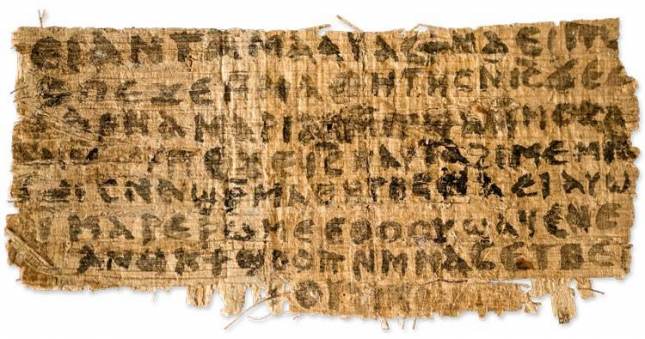
A recent discovery of a papyrus (a thick paper-like material used for writing during the ancient times) has brought focus back to the controversy of Jesus’ relationship with Mary Magdalene once again. There have been many opinions about Jesus being married or having had a relationship with Mary Magdalene, which has been rubbished by the Vatican, but accepted by many.

The papyrus, dated back to 4th Century, though is not a proof to the above, has some words which might mean that Jesus was married to Mary Magdalene. But this we will see later, first let’s understand, a little bit about just who was Mary Magdalene, if there was one.

Mary Magdalene kneeling at the cross
Mary Magdalene was considered to be one of the most devout followers and disciples of Jesus. Many of the Gospels have shown Mary with Jesus right till his end, and Mary was supposed to be the first of all, who saw him after resurrection. Some versions say that she was the first apostle to see Jesus post-resurrection and it was she who was advised to go and inform the other apostles about Jesus’ resurrection. It is for this that many have referred Mary Magdalene as the ‘apostle to the apostles’.


Many have said that Mary was a prostitute who was reformed by Jesus; however, some claim that it was not Mary Magdalene, but Mary of Bethany. This confusion is understandable, as Jesus was surrounded by many Mary’s, one being his mother, the other being Mary Magdalene and many other women by the same name, since Mary was quite a common name then. Also there were many who were similar to the description of Mary Magdalene, and thus the confusion. Also, there have been numerous instances when Jesus has been referred to have kissed Mary, however, this cannot be seen as an ‘evidence’ of the relationship, as greeting a fellow Christian believer by way of kissing was a common practice then.

The papyrus found is of the size of a credit card and has words which translates to “Jesus said to them, ‘my wife’”, might mean that Jesus is referring to Mary Magdalene. Harvard Professor Karen King has said that Jesus was married to Mary in the early part of her career and with this she feels she has reached closer to conclude that Jesus was indeed married. However, Vatican has released a note that they do not agree with Prof King’s ‘findings’ and negate it.

One of the arguments that scholars put forward is that bachelorhood was a rarity in adult male Jews during the time of Jesus Christ and was considered to be a sin as according to a divine commandment, they were supposed to “Be fruitful and multiply”. Also, Mary Magdalene appears very often in the life of Jesus, as compared to other women, and was with him right till the end of his life, something that would be expected only from a wife.

What is interesting is the aggressive stand taken by the clergy on insisting that Jesus was a celibate. Would his married status reduce the divinity of Jesus? Would his married status rob him of the cause that he lived and died for by sacrificing himself for the children of God? Why is the tag of a celibate so important? After all, divinities from all religions have had wives/consorts, be that Buddha, the Prophet or the entire Hindu Pantheon. Would Jesus’ taking a wife, imply that he too had human-like qualities or that he loved a particular woman more than the others, thus negating the theory that Jesus loved all equally? Seems like Jesus’ marital status has more to it than what any of us mere mortals would understand!

Matters of faith have always been judged by the heart, and logic does not find a dwelling place in the heart. But with the changing times, shouldn’t we be more forward looking rather than take recourse to what was said and implied thousands of year’s back, which might have been relevant to the times? Should a single act, if true, reduce the halo of an already elevated person?

Food for thought or should I say, a little wine for the soul!!


The above painting of Mary Magdalene kneeling at the cross is by Gabriel Wuger 1868