A Blog on Mythology and occasionally on Reality.


This is a Blog on Mythology, both Indian and World and especially the analysis of the myths.

In effect, the interpretation of the inherent Symbolism.


Pages

Showing posts with label Mahishasura. Show all posts

Monday, September 29, 2014

Worship of Shakti


Victor Hugo is supposed to have said, “Woman is the most sublime ideal", and it is this sublimity that we celebrate during the Navratri, the ideal that a woman is. The principle of Shakti is invoked and the nation worships this feminine principle which is the driving force behind the world.

According to Devi Mahatmya, once upon a time, there was a demon, who had threatened the very existence of the universe. Due to the boons he had received during his numerous penances, he had become invincible; at least the gods couldn’t do much harm to him. All the gods got together and breathed their energies into a powerful ball of energy, which shaped to form the Shakti. This Shakti was responsible in eliminating the demon, after a waging a powerful war, where the demon took different shapes to elude the powerful force, but at the end die in her hands. The goddess came to be known as the Mahisasur-mardini, the slayer of the buffalo-demon, and the quintessential woman-power.

On earth, we commemorate this divine act of the goddess and celebrate, Navratri, Durga Puja, etc.

Durga slaying Mahisasura
The principle of Shakti cannot be undermined, rather, any god without its shakti is meaningless and a beautiful verse explains this as candid as शक्ति के बिना शिव भी शव के समान हैं, i.e. without Shakti, Shiv is like a dead-body. Shakti is the personification of the divine feminity, the creative powers of the earth. No god is complete without this principle of Shakti, and together they create a beautiful harmony of the union of the two principles, the purusha and prakriti, the union of which is the root of all creation on earth.  

Hold it, I think, I have got a trifle carried away in my explanation of some concepts which only make good scripts, and just that. Did you like that? If you did, then let me pat my back, to say that I do write well. Don’t make that face; humility is not the domain of men! Such behaviour on our part is confidence, awareness and truth; however, if such behaviour was expressed by a woman, then they would be over-confidence, arrogance and brazenness! Whoever said, the world was equal, don’t believe her – aren’t there mountains and valleys on the same surface of the earth?

The earlier paragraph is a utopia painted with all the colours of the rainbow, and more. Those words of wisdom were only to make the women folk feel good and raise them to an altar after treating them like paanv-ki-jooti, for major part of the year and in more than 90% of our country. These occasional rhetoric of Shakti, etc. served well, to ensure that the women-folk got back to the grind, the fields, the kitchen and the beds to cater to all the needs of the man, and the society at large! And just in case a solitary one, did not, then there were means to bring them back to senses – kangaroo-courts, Khaps, stoning to death, rape and murder, naked-parade, etc. If nothing, it served its purpose well in others, who wouldn’t dream of any misdemeanour as inane as staring eye-to-eye with ones younger brother, leave alone any boy!

What a manly sense of achievement! First raise them to an altar, and then drag them to your beds. First talk them into such harmless divinity and them have them croon whatever you want. First offer them some rituals and then ensure that they perform ritually for you.

Dear Indians, let’s get off the high-horse of big talk, and take stalk. Except in a few homes and an even fewer Corporate, the woman is a second-class citizen, if one at all. Let’s not resort to such fancy concepts, if we don’t mean it. As a nation, we have failed our women, when one Nirbhaya takes place in Delhi and the other follows suit in Mumbai, Badaun, and just about everywhere else. If we still have to enact laws to catch hold of them legally, then we sure have failed as a society. If our politicians tell us what women should wear and what they should not, just to avoid getting raped, then such talk of Shakti is pure high-decibel talk and that’s it, and if such politicians who suffer from verbal diarrhoea too often, still move around freely in our society, then let’s take some blame for allowing the moronic retrogrades to move around freely.

A society, which feels proud to allow their men to behave like stray dogs and is not ashamed to ask the women to cover themselves, since the salivating strays cannot be controlled, then stop worshipping the feminine principle – it’s a sham, if not shame!

Ma Durga, my apologies for writing what I wrote, but sorry to tell you, that this is the truth, sordid but truth. The eulogies die a quiet death, even before you turn your back and are yourself reduced to left-over’s in rivers and ponds. I am rather appalled, that you are unable to control the terror that has been unleashed on your daughters by a certain segment of your own followers, especially when the victims had faith in you.
 
Image Courtesy – Taproot India’s campaign ‘Abused Sisters’
I dare you to show us that you care for the daughters of this country, and I further dare you to show the principle of Shakti that I so eloquently waxed, a few paragraphs back.

Or retire hurt……..

Thursday, October 10, 2013

Durga Puja and Lord Ram


Durga Puja begins today and is an important festival in West Bengal and the Eastern parts of the country and the entire Bengal wears a festive look. People celebrate the festival with all the gaiety and revelry that goes along with it.


Durga Puja is the celebration of the killing of the Mahishasura (This is Utkarsh Speaking: Mahishasura ) who had become a threat to all the gods and humans and was invincible except by a woman, due to a boon. After a fierce battle, Goddess Durga kills the demon.


However, this festival initially did not take place at this time of the year. An interesting need-of-the-hour is the cause of the celebrations at this time.


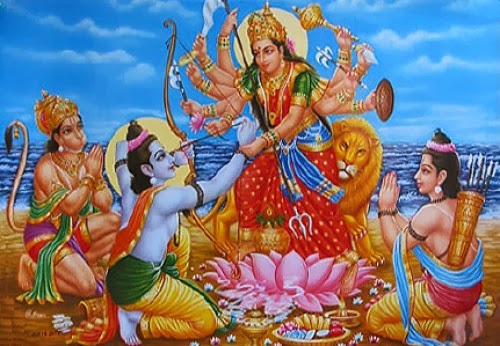
According to the Bengali Ramayan by Kritibash, Goddess Durga was worshipped in the spring season (and thus Durga Puja was also referred as Basanti Puja, the festival in the spring season), and never in autumn. But after an inconclusive battle with Ravan for many days, the gods advised Lord Ram to propitiate Goddess Durga and seek her blessings. But Goddess Durga was never worshipped in autumn, and thus Ram’s propitiating the Goddess is referred to as Akal-bodhan, akal meaning out-of-turn or out-of-season and bodhan meaning worship or invocation. In due course of time, the region started celebrating Durga Puja during the autumn and thus the festival is also known as the sharad-utsav or the spring-festival.


According to the same version of Ramayan, Ram took the blessings of Durga on the sixth day (Sashti) i.e. today, and went into battle with Ravan on the seventh day (Saptami) and killed Ravan at Sandhikshana or during the crossover between the eighth (Ashtami) and the ninth (Nabami) day, and cremated on the tenth day (Bijoya dashami).


The worship of Durga by Ram too has an interesting legend. According to some versions, Ram was advised to worship the goddess as she was considered to be the patron deity of the land of Kuber, i.e. Lanka before Ravan usurped it from Kuber and it would be in order to seek her blessings before invading the island. It is said that Ram needed 108 ‘neel kamal’ or blue lotuses to offer the goddess Durga and after a lot of efforts managed to get only 107 of them. Ram was also referred to as ‘rajiv-nayan’ or the one with eyes like lotus, and since he could not arrange for one more to complete a hundred and eight, he offered his eye by trying to pierce it with an arrow, but the goddess appeared at the right moment and granted him the blessings of victory. Some versions say that Ram did manage to get all the required lotuses, but the goddess hid one to test his devotion.


Since then, this has been a practice to propitiate Goddess Durga before heading for a war and the same is seen in Mahabharata, where Arjuna and Yudhishtir are mentioned to be worshipping Goddess Durga for the boon of victory. Later in history, we have seen Shivaji worshiping Goddess Bhavani, a form of Durga before heading for any battle.


It is interesting to see gods in their own right seeking blessings from goddesses prior to a battle. The cult of Mother Goddess was prevalent from the ancient times and Goddess Durga has always had a unique place in the pantheon. Though she is a goddess created by the gods to fight a demon, she does it without the direct help of any gods. She fights a relentless battle, till she eliminates the evil force, Mahishasura, who was threatening the universe and all the gods with his power. To sustain such a dominating feminine power, Shakti, it was imperative that the later puranic texts perpetuated her position of someone who has been victorious in battle.


Another interesting theory is that Goddess Durga was associated with mountains, (she is also referred to Vindhyavasini, one who resides in the Vindhyas, Parvati meaning daughter of the mountain or parvat, Vaishno devi, again residing in the mountains, to name a few) and was probably a deity of the locals who resided around mountains, where the terrain was tough. Such regions were at the periphery of civilisations and thus many a tribal community or marginalised sections of the societies dwelt in such regions. According to this theory, Goddess Durga is seen to have had her origin in such areas. Puranic heroes, like Ram, Arjuna, etc. worshiping the goddess indicates the assimilation of such goddesses in the mainstream pantheon, leading to the assimilation of the marginalised sections of the society into mainstream civilisation.


The above can be seen as an interesting example of mythology having a laudable function at its core, besides telling interesting myths.


Thursday, October 14, 2010

Mahishasura

All of us know who is Durga and how she kills the demon called Mahishasura.
But who is Mahishasura?

Once upon a time there were two demons by the name of Ramba and Karamba who were the sons of the demon Danu. They decided to undertake penance and so Karamba entered in water and Ramba entered in fire. Seeing the severity of the penance, Indra (the king of gods) felt insecure and decided to eliminate them before they could become a threat. Indra took the form of a crocodile and killed Karamba who was in the water. Seeing his brother dead, Ramba got scared and decided to commit suicide before Indra reached him.

Seeing the plight of Ramba, Lord Agni stopped him and granted him a boon. Ramba asked for a son, who could never be killed by a mortal or an immortal. Agni granted him the boon. On his way back, Ramba saw a beautiful demoness who was in the form a buffalo. He fell in love with her and took her home. At night when they were making love a buffalo charged in and killed Ramba. The grief-stricken demoness decided to kill herself and jumped onto the funeral pyre of Ramba.

But the boon of Agni could not be wasted, so from the funeral fire was born a child who was later known as Mahishasura – the buffalo demon.

Ramba’s relatives brought up Mahishasura to be their king. When Mahishasura grew up, he undertook a severe penance and pleased Lord Brahma. On Lord Brahma’s asking he got a boon from him that no man could kill him. At that point of time, it had never occurred to him that a woman could even think of killing him. Having got the boon, Mahishasura became a threat to the gods, till the gods invoked their energy to create a female principle in the form of Devi Durga to kill him after a violent nine day battle.

This is the story of Mahishasura – the buffalo demon.

The above is a statue of Mahishasura at Chamundi Hills in Mysore